Solid foundations in literacy
In grades 1 and 2 we lay the foundations of Czech literacy through phonics instruction and daily reading. Pupils progress at their own pace. We write in Comenia Script — a font more natural for fine-motor development.

At FLOW we build solid foundations in reading, writing, maths and Czech — and then put them to work in authentic projects that lead children to a real understanding of the world.
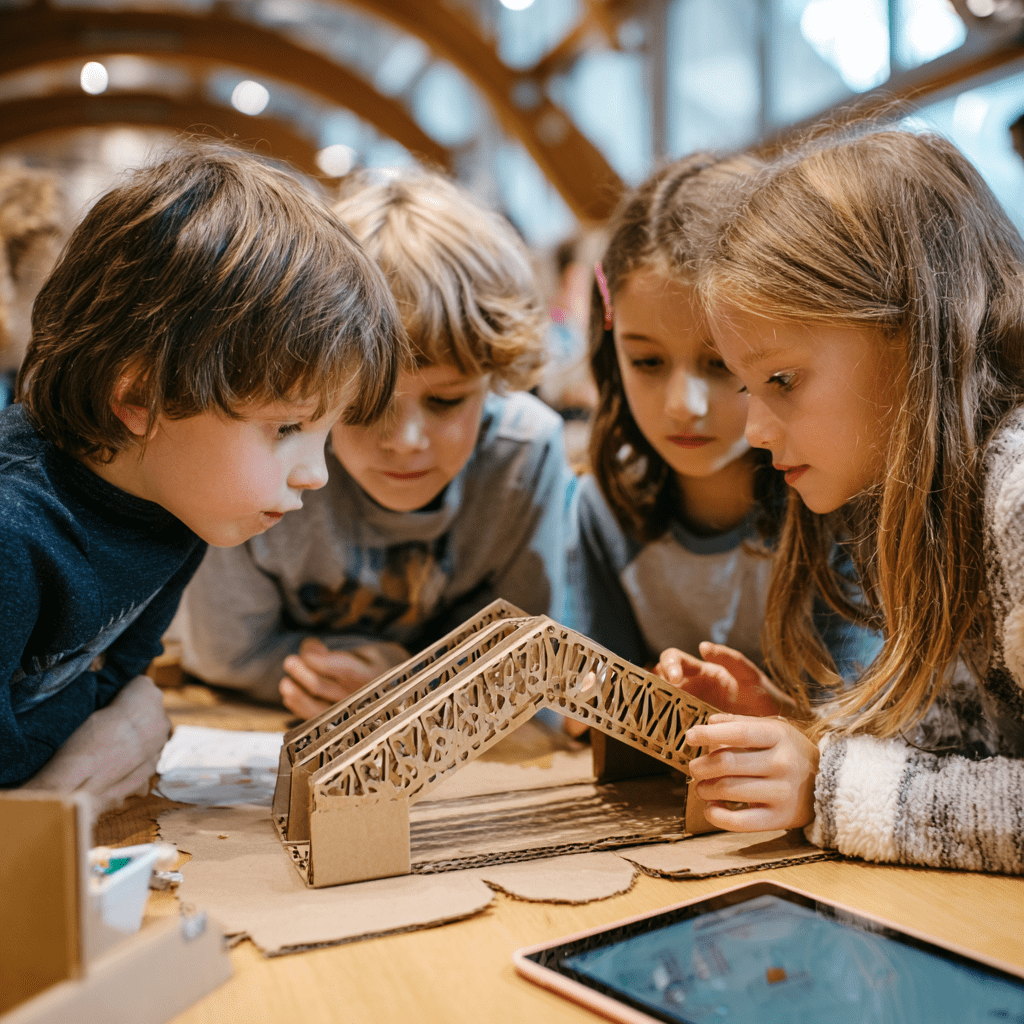
We build on solid foundations — and put them to use right away. Children don't learn for a test, they learn for the real world.
— the FLOW pedagogical approach
Every class has its own timetable. This is just an illustrative example — subjects flow into projects in real lessons. English is taught not only as a standalone subject but also woven into other chosen subjects (CLIL — Content and Language Integrated Learning).
| Day | Block 1 8:30–10:00 | Block 2 10:30–12:00 | Block 3 13:00–14:30 |
|---|---|---|---|
| Mon | Czech | Maths | English / IT |
| Tue | Czech / English | PE | English / IT |
| Wed | Art | English / Czech | People & their world |
| Thu | Maths | Czech / People & their world | Personal development |
| Fri | Czech | Art | After-school club / activities |
The day starts with morning circle — sharing, planning the day, preparing for the first block. The day ends with a snack and the after-school club or activities — sports, music, art, languages. No bells, no rush.
In grades 1 and 2 we lay the foundations of Czech literacy through phonics instruction and daily reading. Pupils progress at their own pace. We write in Comenia Script — a font more natural for fine-motor development.
Preparation for the entrance exams to eight-year gymnasiums is built into the whole year — pupils don't cram "for the test" in the final months but gradually build confidence. By exam day, they're ready.
We combine the Hejný method (learning through discovery and personal experience) with a classical approach (systematic practice, confidence with basic operations). For each child and each area, we choose what makes sense.
The result: children find joy in mathematical thinking while also having a firm foundation — they tackle word problems with confidence and do mental maths fluently.
Pupils explore relationships and logic (Hejný), then we systematically consolidate them with classical practice.
Concrete models (wooden blocks, visuals) lead to abstract thinking — and paper drills build speed.
Word problems and open-ended problems grow thinking. A short daily drill secures confidence in basic operations.
Mixed-age groups and individual pacing ensure every pupil is challenged where it makes sense for them.
Our projects aren't isolated assignments. We work with ten types of relationships children need for a full life — and each theme translates into specific projects across subjects. Roughly 10 major projects run each year.
Notice the world around you, understand ecosystems, take and give back.
ExamplesOur river · Recycling in practice · A tree across the year
Self-awareness, emotions, boundaries, identity. Understand yourself first.
ExamplesMe at 10 · My strengths · Emotions in colour
Community, democracy, helping. Being part of the whole, not a detached unit.
ExamplesOur parliament · Helping seniors · Our city in 50 years
Openness to other perspectives, the value of creation, respect for tradition and for difference.
ExamplesStories from around the world · A gallery in the classroom · Our traditions
History, continuity, planning. Understanding that the present is a consequence of what came before.
ExamplesA day in the Middle Ages · A family timeline · The world in 100 years
What is true, how to find a source, critical reading. A key skill in the age of AI.
ExamplesWhat is fake news · Searching the sources · The library as a source
Create, don't just consume. Technology as a tool, not a toy.
ExamplesFirst lines of code · Build a robot · My tool for the task
Stewardship, sustainability, value. We don't waste what we value.
ExamplesWater in everyday life · The energy around us · Less, better
Craft, perseverance, problem-solving. How to take an idea all the way to a result.
ExamplesA paper bridge · Our reading room · A business for a day
Adaptation, growth, coping with the new. Change is the only constant — let's learn it.
ExamplesSeasons in nature · My growth over a year · Adapting to the new
Pupils present their projects to a real audience — a class exhibition, a school meeting, members of the community. They take home portfolios that document the learning journey, not just the final result.
No subject exists in isolation. Everything feeds into the project blocks and enriches the others.
Integrated into projects — helping pupils understand the world and their place in it. Instead of dates and names: connections.
Practical, inquiry-based learning — from life cycles to states of matter. In the field, in the lab, in the garden.
Not an add-on to the "important" subjects, but a fundamental way of expressing understanding and developing creativity.
Builds fitness, coordination and a lifelong love of movement. No discipline-driven drills — with joy.
A short form — 5 fields. Within 1 business day we'll confirm or suggest an alternative.